Pacific People’s Power Forum Unites Asia Pacific Voices for Justice and Equality
PRESS RELEASE
Pacific People’s Power Forum Unites Asia Pacific Voices for Justice and Equality
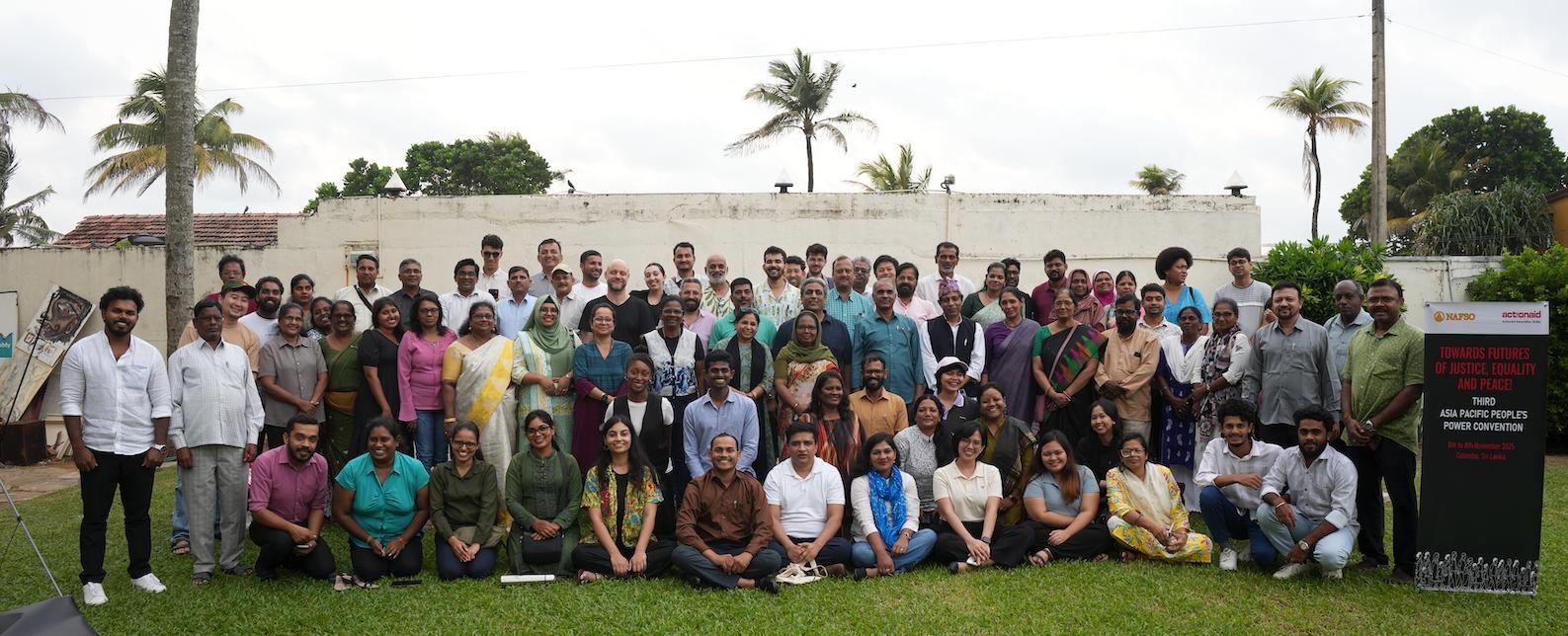
COLOMBO, Sri Lanka | November 6–7, 2025 – The Third Asia Pacific People’s Power Convention, jointly hosted by ActionAid Association (India) and the National Fisheries Solidarity Movement (NAFSO), continued for its first two days in Colombo, bringing together activists, workers’ leaders, feminist thinkers, and human rights defenders from across the region and beyond.
The three-day forum serves as a platform for emerging and established movements to engage in dialogue on critical issues — from democratic rights and gender equality to climate justice, workers’ dignity, and peacebuilding across the Asia Pacific.
The opening day began with a vibrant Kandyan dance performance, followed by inaugural remarks and a panel of leading human rights lawyers and workers’ movement leaders. Speakers called for deepening solidarity across struggles as the region faces intersecting crises of inequality, conflict, and ecological breakdown.
Mr. Pradeep Wanigasuriya, Secretary, NAFSO, welcomed participants and expressed hope that the deliberations would “show the way towards just futures for all in the Asia Pacific region.”
Ms. Shreen Abdul Saroor, Commissioner, National Commission for Women, Sri Lanka, urged participants to work toward a future “where governments serve their citizens, where human rights are not optional, and where peace is built not on silence, but on justice and accountability.”
Mr. Sandeep Chachra, Executive Director, ActionAid Association, thanked NAFSO for hosting the forum in “the beautiful island nation of Sri Lanka.” Reflecting on the struggle between darkness and dawn, he called on working people and excluded communities “to unite, dream, and act together — to build a new dawn of justice, equality, freedom, and peace.”
Ms. Swasthika Arulingam, President, Industrial and Commercial Workers Union, Sri Lanka, discussed the challenges of confronting neoliberal capitalism and reaffirmed the need to revive the principles of socialism to ensure equality and dignity for all.
A special youth panel examined the growing wave of youth-led movements across Asia Pacific, including the recent student protests in Nepal. In an engaging Q&A, young leaders shared strategies for sustaining Gen Z–driven movements and translating protest into lasting change.
The day closed with a session on peace and solidarity, focusing on the Middle East and South and Southeast Asia. Panellists explored strategies such as civic education, economic boycotts of aggressors, and cultural activism as tools for advancing justice and peace.
The second day of the convention opened with a powerful session on feminism and the future of work, led by Ms. Dipali Sharma, Director, Programmes and Partnerships, ActionAid Association. She urged participants to rethink the definition of work and the place of women within it, asking, “What does a feminist future in the world of work look like?” Speakers shared vivid accounts of the harsh realities faced by women workers in sectors such as tea plantations, garment production, and sanitation, emphasizing the urgent need for fair wages, safety, and recognition.
In a subsequent session on land and rural futures in the Asia Pacific, Professor M.G. Kularante, University of Kelaniya, led discussions on the political economy of land and the intersection of rural livelihoods with climate justice, just days before COP30 in Brazil. Ms. Alisi Rabukawaqa-Nacewa, Melanesia Council of Elders and Pacific Climate Warriors, highlighted the existential threats facing Pacific island nations due to rising seas and shoreline erosion.
Dr. Ramani Jayasundara, Chairperson, National Women’s Commission, Sri Lanka, delivered a moving address on feminism and human rights defenders, tracing the long struggle for women’s rights and gender equality in Sri Lankan public policy.
The evening sessions featured a dialogue among human rights defenders on safeguarding activists from political repression and censorship. The day concluded with a plenary on “Pathways to Just Futures in the Global South,” where speakers underscored the need for renewed South–South solidarity to advance justice, equality, and sustainability for people and the planet.
The Pacific People’s Power Forum continues to serve as a space of reflection, solidarity, and collective action — affirming that justice and peace in the Asia Pacific must be built through the courage, imagination, and unity of its peoples.